Tel: 01467 671264
Fax: 01467 671282
Email:
KirkdaleNurseryDaviot@gmail.com

Opening Hours (Winter)
Nov - Mar 10 a.m. - 4 p.m.
Opening Hours (Summer)
Apr - Oct 10 a.m. - 5 p.m.
7 Days a week
Sorry - No Mail Order Service
Tel: 01467 671264
Fax: 01467 671282
Email:
KirkdaleNurseryDaviot@gmail.com
Opening Hours (Winter)
Nov - Mar 10 a.m. - 4 p.m.
Opening Hours (Summer)
Apr - Oct 10 a.m. - 5 p.m.
7 Days a week
Sorry - No Mail Order Service
Ornamental Tree Information
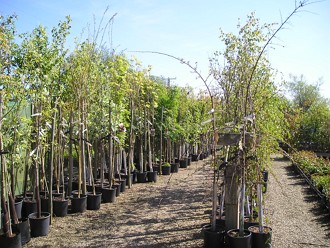 Below are descriptions for some of our ornamental trees, with more due to be added in the near future.
For our complete range of ornamental trees, please click here.
Acer Alnus Aesculus Betula Cotoneaster
Acer (Maple, Sycamore)
Acers, commonly known as maples or sycamores, are deciduous trees that produce magnificent colours in autumn. They are found in North America, Europe, Eastern Asia and a small area of North Africa and make excellent specimen trees for any size of garden. Acer trees typically grow to heights of 10m to 45m depending on the variety. Although small, acer flowers can be eye catching when the whole tree is in bloom, usually in spring. Acers can also produce fruit, known as samaras or maple keys, which resemble small helicopters.
Acer campestre “Carnival” (Variegated Field Maple, Carnival Hedge Maple) (12L)
A spectacular small spreading tree that originally occurred as a chance seedling in Holland in 1989. The distinctive young lobed foliage is pink in colour and turns green with creamy white margins and pink tips in summer. During autumn, the leaves turn a buttery yellow with cream margins. Yellow/green clusters of flowers in spring and winged seeds that are often referred to as helicopters. Dense branches. Ideal for small gardens and brightens up a dark corner. Prefers moist, well drained soil. Suitable for partial shade; can be scorched by the sun. Should be pruned hard in winter to increase leaf size. Slow growing, reaching a height and spread of 2m x 2m after 10 years.
Max. Height: 3-4m Max. Spread: 3-4m
Acer cappadocicum “Aureum” (Golden Cappadocian Maple) (12L)
An attractive spreading maple with bright green oval leaves which turn vivid yellow in autumn. Produces pale yellow flowers followed by winged fruit. Should be sheltered and intolerant of urban pollution. Deer tolerant. Can be planted in front of an evergreen backdrop to great effect, which contrasts with the vibrant foliage of this tree. Prefers neutral or mildly alkaline soil and either full sun or partial shade. Can be a difficult tree to grow, but highly rewarding; Acer pla. “Princeton Gold” is a suitable alternative with yellow foliage that is easier to grow. Reaches maturity after 20-50 years. RHS Award of Garden Merit.
Max. Height: 15m Max. Spread: 10-12m
Acer cappadocicum “Rubrum” (Red Cappadocian Maple, Red Caucasian Maple) (12L/7L)
A relatively uncommon, medium-sized maple with a fantastic variety of colours that dates back to the early 19th century. Large leaves which are initially bright red, turning green and finally a vibrant golden yellow throughout autumn, with some red as well. Bright red young stems. Produces flowers in spring followed by winged fruit in autumn. Prefers full sun or partial shade. Suitable for most soil types, but does particularly well in moist, well drained and acidic soils. Particularly effective when planted against a backdrop of green leaved trees or as a specimen tree. Easy to grow, often requiring no pruning at all, and benefits from some shelter from strong winds. Rounded growth habit. RHS Award of Garden Merit.
Max. Height: 12-15m Max. Spread: 10-12m

Acer davidii “George Forrest” (Père David’s Maple “George Forrest”, Snakebark Maple) (7L)
An attractive tree with a pendulous growth habit, one of the largest snakebark maples. Large dark green leaves which usually turn first orange then golden yellow in Autumn. Bright red leaf stalks. Fantastic green and silvery white striped bark and spreading branches (the bark is red/purple when the tree is young). Light yellow flowers in early/mid spring and pink/brown fruit. An excellent specimen tree for medium-sized gardens. A vigorous grower, rapidly attaining a height of around 10m and reaching up to 15m (20m in exceptional cases) at maturity after 10-20 years. Prefers moist, neutral to mildly alkaline soils but does not tolerate chalk. Full sunlight should be avoided to prevent the foliage being scorched.
Max. Height: 10-15m Max. Spread: 10-15m
Acer davidii “Karmen” (Père David’s Maple “Karmen”, Snakebark Maple) (20L)
A relatively small and striking snake bark maple. Deep bronze/brown young foliage which turns reddish green in summer then orange/yellow in autumn. Typical white striped bark. Produces numerous pendant-shaped yellow flowers in spring. Prefers full sun or partial shade. Suitable for fertile, moist and well drained soils. Reaches maturity after 10-20 years.
Max. Height: 8-10m Max. Spread: 10-15m
Acer ginalla “Flame” (Maple “Amur Flame”, Tatarian Maple)(7L)
A small, multi-stemmed bushy maple with spectacular and reliable autumn colour. Dense bright green foliage which turns a brilliant fiery red/orange in autumn. Fragrant yellow/white flowers that bloom in spring (April/May). Rough grey/red bark. An excellent accent plant. Can be planted approx. 2-2.5m apart to form a deciduous hedge. Low canopy, typically just above 1m from the ground. Highly tolerant of urban pollution. Suitable for virtually all soil types, and adapts well to wet or dry, acidic or alkaline conditions. Prefers full sun but suitable for partial shade. Also classified as Acer tataricum ssp. Ginalla “Flame”.
Max. Height: 6-8m Max. Spread: 5-6m
Acer griseum (Paper bark maple) (12L/7L)
An excellent, relatively small maple renowned for its magnificent dark orange/copper peeling bark, which when removed reveals reddish under-bark. Pale yellow/green young trifoliate leaves which turn dark green in summer and an attractive dark red/crimson in autumn; a variety of shades are seen over time. Flowers in April and May. Introduced to Britain in 1901 from China. Suitable for full sun or light shade. Prefers moist, well drained soil which is slightly acidic. Suitable for coastal planting, and should be sheltered if possible. An excellent lawn specimen. Slow growing. RHS Award of Garden Merit.
Max. Height: 6-10m Max. Spread: 6-10m
Acer grosseri var. “Hersii” (Hers’s Maple, Snakebark Maple)(12L)
A striking snakebark maple that originates from China. The green leaves turn vivid shades of yellow, orange and red in autumn. Upright tree with arching branches, giving a distinctive silhouette. Attractive marbled bark, green with silvery white stripes. Noticeable fruit borne on long racemes. Suitable for small gardens. Prefers most moist, well drained soils. Suitable for full sun or partial shade. Can be pruned in winter to the desired size. RHS Award of Garden Merit. Grows rapidly when young, before slowing down towards maturity (at 10-20 years).
Max. Height: 10-15m Max. Spread: 8-15m
Acer micranthum (Komine Maple)(12L)
A small, unusual and striking maple that originates from Japan. Uncommon in the UK. Attractive , five-lobed green leaves (briefly red after emerging) which turn bright orange and red in autumn. The slender and arching branches gain a red tint in autumn and winter. Prefers full sun or light shade. Suitable for well drained, mildly acidic soils.
Max. Height: 5-9m Max. Spread: 4-6m
Acer “Pacific Sunset” (Acer truncatum x Acer platanoides “Warrenred”) (12L)
An outstanding medium-sized maple. A hybrid of Acer “truncatum” and Acer “platanoides”, introduced in 1990. Upright, spreading growth habit. Glossy dark green leaves which turn yellow, orange and red in autumn. Flowers during April. Suitable for most soil types, with a slight preference for acidic soils. Drought tolerant. Prefers full sun but tolerates light shade. Very tolerant of urban pollution.
Max. Height: 8-10m Max. Spread: 7-8m
Acer platanoides “Crimson King” (Norway Maple “Crimson King”) (12L)
A large, fast growing maple which spreads to give a rounded crown. Striking deep red/purple leaves which turn red, brown and orange in the autumn. Produces yellow flowers with red tips in early spring (April and May). An excellent specimen tree for a large garden. Can be easily pruned to restrict the spread. Suitable for almost any soil type, does particularly well with a moist, fertile and well drained soil. Prefers full sun or partial shade. Highly tolerant of urban pollution. RHS Award of Garden Merit.
Max. Height: 15-20m Max. Spread: 12-15m
Acer platanoides “Crimson Sentry” (Norway Maple “Crimson Sentry”) (15L)
A densely branched, upright tree which is very hardy; this variety can be found inside the Arctic Circle. Relatively slow growing and smaller when compared to other Norway maples. Dense, bright red young leaves which darken to a deep purple/red during summer before brightening to vibrant red and orange in autumn. Green/yellow flowers in spring (April and May). A good choice as an avenue tree or as a specimen tree for a medium sized garden. Should be grown in a location where vigorous surface roots are not a problem. Prefers acidic soil, but tolerant of poor quality soils. Suitable for full sun or partial shade. Drought, pollution, deer and wind tolerant. Reaches maturity after around 20-40 years.
Max. Height: 12m Max. Spread: 5m
Acer platanoides “Drummondii” (Silver Variegated Maple, Harlequin Maple) (12L)
An attractive, round-headed tree with a vigorous growth rate that is often considered the best Norway maple. Pale/dark green variegated leaves with wide creamy white margins which turn orange in autumn. Yellow flowers with a red tinge in spring (April and May). An excellent specimen tree for a medium/large garden. Should be grown in a location where vigorous surface roots are not a problem. Drought, deer and pollution tolerant. Prefers full sun or partial shade. Suitable for most soil types, but prefers acidic, fertile, moist and well drained soils. Reaches maturity after 20-50 years.
Max. Height: 15-25m Max. Spread: 12-15m
Acer platanoides “Princeton Gold” (Norway Maple “Princeton Gold”) (12L)
A very attractive and relatively short Norway Maple that is ideal for a smaller garden. Stunning golden yellow young leaves with red stems, which turn a strong lime green/gold in summer and orange in autumn. Pale yellow/green flowers in late spring. Prefers full sun (resistant to scorching in the UK’s climate) but tolerates partial shade. Suitable for fertile, moist and well drained soils but adapts to almost any soil type. Grows to a height of 8-10m after 10 years with a spread of 5-6m. High disease resistance.
Max. Height: 10-15m Max. Spread: 8-10m
Acer pseudoplatanus “Brilliantissimum” (12L)
A popular spreading sycamore (European maple) introduced in the early 20th century with notably striking foliage. Shrimp pink leaves which initially turn pale bronze/yellow and then green by early/mid summer. Produces yellow/green flowers during April and May and red-winged fruit in late summer. Relatively small and slow growing, reaching maturity after 25-50 years. Excellent for small gardens and a good choice as a specimen tree. Suitable for all soil types, but prefers acidic/neutral and moist, well drained soil. Prefers full sun or partial shade. Wind and pollution tolerant and suitable for coastal sites. Should be protected from frost damage if possible. RHS Award of Garden Merit (2002).
Max. Height: 6-8m Max. Spread: 8m
Acer pseudoplatanus “Prinz Handjery” (12L)
A very attractive spreading sycamore (European maple) similar to Acer pse. “Brilliantissimum” but with a more open habit and a more vigorous growth rate. Rarely available in the UK. Intense salmon pink young leaves in spring which turn pale bronze then green with dark purple undersides in summer. Yellow flowers. An excellent maple for a small garden. Suitable for fertile, moist and well drained soils. Prefers full sun or partial shade.
Max. Height: 7-8m Max. Spread: 7-8m
Acer pseudoplatanus variegatum “Simon-Louis Freres” (12L)
A slow growing and broadly spreading tree with eye catching foliage. Broad leaves which are a brilliant deep pink in spring before losing most or all of this colour and turning green with creamy white and purple/pink stripes and blotches on the upper side of the leaf. Yellow/green flowers in spring (April and May). An excellent lawn specimen. Grows to a height of 5m after 10 years. Can be pruned to limit size and to enhance the quality of the leaves. Prefers full sun or partial shade. Suitable for fertile, moist and well drained soils. Suitable for exposed and coastal sites.
Max. Height: 6-8m Max. Spread: 6m
Acer pseudoplatanus “Worley” (Golden Sycamore, also “Worleei”,“Woorley”) (12L)
A stunning, medium-sized and mop-headed  sycamore introduced from Germany in 1893. Quick growth rate. Light yellow/green young leaves quickly turn a very rich golden yellow which is retained throughout summer, later turning pale green in autumn. Pink fruit in autumn. Suitable for full sun or partial shade. Prefers moist, well drained soil but tolerates most soil types. Tolerant of exposed or coastal sites, but should be sheltered from cold winds if possible.
Max. Height: 12-15m Max. Spread: 10-12m
Acer rubrum “Brandywine” (North American Red Maple “Brandywine”)(12L)
A spectacular classic red maple that gives reliably intense autumn colour in the British climate. The leaves are initially dark green before turning a particularly vibrant red or orange in autumn followed by a deep red/purple. Flowers in April. Smooth light grey bark. Suitable for any fertile and well drained soil, although acidic soils give more intense autumn colours. Prefers full sun or partial shade. Vigorous growth rate. Upright growth habit and oval in shape, and therefore suitable for confined spaces. Should be sheltered from strong winds if possible. Can be expected to reach a height and spread of 7m x 3m after 10 years. Highly resistant to leafhopper. “Brandywine” is a cross between Acer rub. “October Glory” and Acer rub. “Autumn Flame”.
Max. Height: 12-15m Max. Spread: 9-10m
Acer rubrum “New World” (12L)
An excellent maple first introduced in America. Green foliage which turns a variety of shades of bright orange in autumn. Upright and narrow growth habit. Highly resistant to leafhopper and tolerant of urban pollution; this tree is frequently planted on city streets. Tolerates cold as well as hot conditions particularly well. Suitable for full sun or partial shade, and prefers a fertile, well drained soil.
Max. Height: 9-12m Max. Spread: 5-6m
Acer rubrum “October Glory” (12L)
An attractive maple with spectacular and reliable autumn colour. First introduced in America during 1961. Dark green leaves with white/blueish undersides which turn a deep fiery red and dark orange in autumn. Produces small red flowers in April and May, followed later by small red fruit. Smooth grey bark. Vigorous growth rate with an upright habit, initially pyramid in shape before becoming more rounded over time, and unsuitable for small gardens. Prefers full sun to partial shade. Suitable for an acidic, fertile, moist and well drained soil, but tolerates wet soil well; alkaline soil should be avoided as this may have a negative effect on the autumn colour. Tolerant of urban pollution, but can be susceptible to disease and pests. RHS Award of Garden Merit.
Max. Height: 15-20m Max. Spread: 10m
Acer rubrum “Somerset” (12L)
An impressive medium-sized maple with excellent and reliable autumn colour, which is retained for longer than most other maples. Bright green leaves that turn an intense deep red in autumn. Produces small light red flowers in spring. Smooth light grey bark which turns red over time and is particularly eye catching in winter. Does not produce fruit. An excellent specimen tree for larger gardens. Prefers moist, well drained soils but tolerates wet soils. Suitable for full sun or partial shade. Tolerant of urban pollution. Highly resistant to leafhopper. From the same research programme and parentage as “Brandywine”, a cross between Acer rub. “October Glory” and Acer rub. “Autumn Flame”.
Max. Height: 12-15m Max. Spread: 8-12m
Acer rubrum “Summer Red” (12L)
An excellent maple noted for its spectacular summer and autumn foliage, thought to have been introduced to Britain in the 17th century. The young leaves are a vibrant crimson and develop a green/purple colour before turning crimson and yellow in autumn. Dark red stems. Small red flowers in early spring (more reliable with older trees). Does not produce fruit. Dark grey bark which flakes irregularly. Tolerates most soil types, preferring well drained soils. Suitable for full sun or light shade. Drought tolerant. Upright habit and vigorous growth rate; this tree can be expected to reach a height of 6m after 10 years.
Max. Height: 20m Max. Spread: 14m
Acer rubrum “Sun Valley” (12L)
A relatively recently introduced maple from the USA with particularly long lasting and vibrant autumn colour. Has a vigorous growth rate and forms a dense symmetrical crown. The leaves are initially copper brown in spring, becoming a medium green in summer before turning a brilliant red/orange in autumn. Reddish flowers. Smooth, light grey bark which darkens with age. Suitable for most soil types but prefers acidic, moist and well drained soils. Suitable for full sun or partial shade. Resistant to leafhopper. A cross between Acer rub. “Red Sunset” and Acer rub. “Autumn Flame”. Can be expected to reach a height of 7m after 10 years.
Max. Height: 12-15m Max. Spread: 8-10m
Acer rufinerve (Snake Bark Maple) (7L)
An attractive tree noted for its green and creamy white striated bark which gives year-round interest. Broadly columnar growth habit with arching branches. Large dark green leaves which turn bright red, orange and yellow in autumn. Small green/yellow flowers in spring (April and May). Red winged fruit in Autumn that resemble helicopters. Suitable for most soil types, but prefers a moist, well drained soil. Autumn colour is best with slightly acidic soils. Should be sheltered from cold winds and ideal for smaller gardens. Has a slightly slower than average growth rate and can be expected to reach a height and spread of 7-8m x 5m after 20 years.
Max. Height: 10m Max. Spread: 8-10m
Acer x conspicuum “Phoenix” (12L/7L)
A rare and outstanding maple with year-round interest, noted for its impressive autumn and winter bark, which is a vibrant orange/pink colour with bright white stripes. The bark is a pale green/yellow during spring and autumn. A hybrid of Acer “pensylvanicum” from America and the Chinese Acer “davidii”. Large green leaves during summer which turn an excellent golden yellow colour in autumn. Reaches maturity after 20-50 years. Prefers full sun or partial shade, and should be given some shelter. Soil should be moist in summer but well drained in winter. Fairly slow growing, reaching a height and spread of 3m x 2.5m after 10 years.
Max. Height: 9m Max. Spread: 6m
Acer x freemanii “Autumn Blaze” (Acer x freemanii “Jeffersred”)(12L)
An excellent large maple with an upright growth habit and a vigorous growth rate (more so than Acer rubrum). Green leaves with silver undersides and red veins which turn a brilliant fiery red/orange in autumn. Produces yellow/green flowers and red fruit which turn brown. An excellent specimen tree. Suitable for full sun or light shade. Prefers well drained, moist and fertile soils, with acidic soils giving better autumn colour. Requires shelter if planted on a site exposed to strong winds. Reaches maturity after 25-50 years. Can be expected to reach a height and spread of 10m x 5m after 10 years. A hybrid of Acer rubrum (noted for its colour) and Acer saccharinum (noted for its vigorous growth rate) first introduced in the 1930’s in the USA, where it remains highly regarded.
Max. Height: 20m+ Max. Spread: 12m
Alnus glutinosa “Imperialis” (Cut Leafed Alder)
A very graceful and slender alder with an upright habit. Exceptional large and deeply cut mid-green leaves that bear some resemblance to maple leaves which turn brown and yellow in autumn. Produces pale purple flowers in late February/March and brown fruit in the summer. Suitable for almost all soils that aren’t dry and thrives even in wet, poorly drained soils; this tree is ideal for planting beside a pond or a stream. Prefers full sun but tolerant of partial shade. Suitable for coastal and exposed sites. Pollution tolerant. Slower growth rate than other alders and can be expected to reach a height and spread of 4-5m x 2-3m after 10 years. Reaches maturity after 20-50 years. RHS Award of Garden Merit.
Max. Height: 8-12m+ Max. Spread: 6-8m
Aesculus incana “Aurea” (Golden Alder)
An excellent eye-catching alder introduced in the 1860’s. Similar qualities to the Grey Alder (or Common Alder) but slower growing and more attractive. Golden yellow leaves and shoots in spring, turning dark green over summer. Long red/pink-tinted yellow catkins, first forming in late autumn and gaining colour throughout winter and into spring. Brown fruit in summer. Attractive bark that turns orange during the winter. Suitable for most soil types although acidic peat and shallow chalky soils should be avoided, and thrives in poor conditions, for example in dry or wet soils and soils with poor fertility. An excellent choice for waterside planting. Prefers partial shade to full sun, requires less light than other alders. Pollution tolerant. Reaches maturity after 20-50 years.
Max. Height: 10-15m Max. Spread: 5-8m
Betula utilis jacquemontii "Snow Queen"
 An excellent medium-sized Himalayan Birch with beautiful and dazzling peeling white bark. The dark green leaves are large, sharply pointed and turn an attractive golden yellow colour in the Autumn. This tree has a preference for acidic, well drained soil and is drought tolerant.
Height: Up to 10m Spread: Up to 8m
Cotoneaster frigidus "Cornubia"
A large, vigorous and hardy semi-evergreen tree with a tall spreading habit. Flowers in May/June (bearing small white flowers) before producing large numbers of bright red berries in late Autumn and throughout Winter, which attract birds. The leaves are large and dark green. Drought tolerant.
Height: 6m Spread: 4.5-6m
Soil: Well drained, moist soil of a moderate fertility.
Position: Prefers full sun or partial shade.
Cotoneaster Hybridus Pendulus
A small and hardy semi evergreen tree with weeping branches. Produces small and attractive white flowers in June before bearing large numbers of bright red berries towards the end of Autumn and throughout Winter. Ideal for a small, sheltered garden. The seeds of the fruit may cause minor stomach complaints if swallowed. Also known as "Cotoneaster salicifolius Pendulus".
Height: up to 2.5m Spread: up to 2.5m
Soil: Well-drained soil with moderate fertility, but can tolerate a wide range of conditions.
Position: Full sun or partial shade.